Brazil arrived in Russia as the bookmakers' favorites, carrying the weight of a 7-1 trauma from four years earlier and the expectation that Tite's pragmatic rebuild would deliver a sixth title. What unfolded was a campaign that felt strangely hollow: dominant in patches。brittle when it mattered, and ultimately ended by Belgium in the quarter-finals. The 2018 World Cup was not a disaster for Brazil, but it was a sobering reminder that talent alone no longer guarantees deep runs.The group stage set the tone. A 1-1 draw with Switzerland in Rostov-on-Don exposed a familiar problem: Brazil struggled to break down compact, physical defenses. Philippe Coutinho's curling opener was a moment of individual brilliance, but the team's response to going behind was labored. Two stoppage-time goals against Costa Rica—Coutinho again。then Neymar—masked a frustrating 90 minutes. The 2-0 win over Serbia in Moscow was more convincing, with Paulinho and Thiago Silva scoring, but the performance still felt controlled rather than commanding. Brazil topped Group E with seven points, yet the sense of invincibility was missing.The knockout stage brought relief and then reality. Against Mexico in the round of 16, Brazil produced their best 45 minutes of the tournament, with Neymar and Roberto Firmino scoring in a 2-0 win that flattered Mexico's defensive effort. The quarter-final against Belgium in Kazan was the turning point—and not in Brazil's favor. Fernandinho's early own goal and a Kevin De Bruyne thunderbolt put Brazil two down inside 31 minutes. Tite's side woke up after halftime。Renato Augusto pulled one back, but the equalizer never came. Belgium's defensive discipline, combined with Brazil's inability to convert possession into clear chances, sealed the exit. It was a defeat that felt tactical as much as emotional.
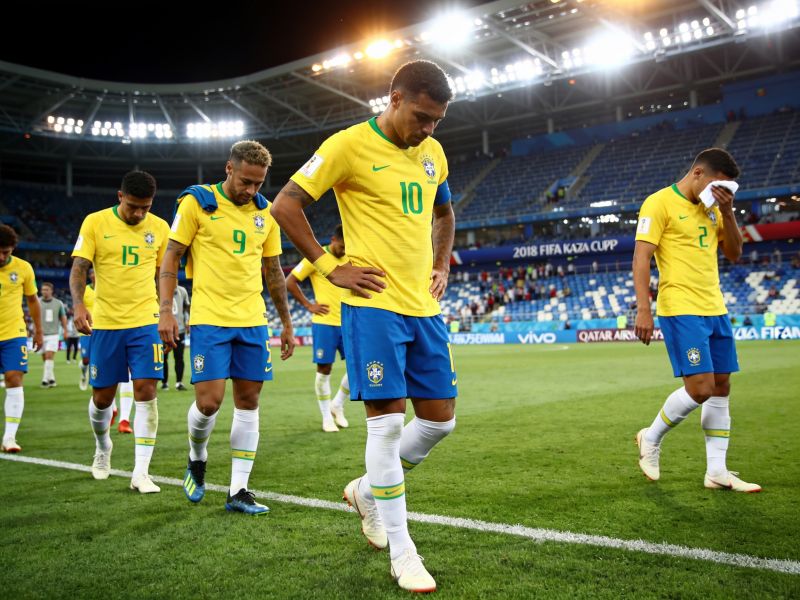
What stands out in hindsight is how little Brazil's attacking stars clicked. Neymar scored twice but spent much of the tournament embroiled in theatrics and physical battles. Gabriel Jesus failed to score in five matches, and the reliance on Coutinho's long-range shooting became predictable. Casemiro's suspension for the Belgium game left a gaping hole in midfield. Tite's substitutions, often reactive rather than proactive。drew criticism back home. The 2018 World Cup was a tournament where Brazil's defense was solid—only two goals conceded in five games—but the attack never truly ignited. That imbalance is what made the quarter-final exit so frustrating, and it shaped the conversation around the team for years afterward.